Returning to Civvy Street
RETURNING TO CIVVY STREET
1961 – 1986
After finishing conscription into the Royal Air Force in 1961 my previous employer who when I left told me that he would keep my job open and true to his word he offered me employment as a shop assistant. I turned the job down because the weekly wage was only £10-00 and I could earn a lot more working as a labourer. I became employed by East Sussex Engineering Co. Which was originally owned by John Every Ironworks and then after the big fire it became The Phoenix Iron Works and then East Sussex Engineering It was 1963 when I bought a van similar to the one in the photograph. When I collected it from London there was another engine and a lorry heater behind the back seat, for a job lot of £10.00. The van had been converted with side windows and split front bumpers. It needed to be crank started every time. Petrol was the equivalent of 25 pence a gallon, NO Mot required. Cheap Insurance With,”Fire Auto Marine” was £15.00 a year fully comprehensive. The owner Amil Savundra was convicted in 1968 and served 6 years of an 8 year prison sentence for fraud. I then used another Insurance company who only lasted 2 years so I played safe and used PRUDENTIAL until 2002.

I bought a Ford van like this one,with extras for £10.0 and then sold it for £25 two years later
I was initially employed as a labourer earning 3 shillings and 9. 15/16th pence an hour .Which is a little under 20p I worked a 48 hour week plus overtime of 7 hours including Saturday morning. My take home money was £11.25p. A year later became the works Lister driver with a pay rise of one and a half pence an hour. The lister was a three wheeled vehicle which was driven by a very powerful diesel engine. It could carry weights of 3 tons and tow 5 tons.
About a year later I became an improver moulder working in what was known as the floor foundry because the moulds could be moulded in the floor. When large moulds were made a hole was dug in sand floor which went to a depth of up to 5 feet and the bottom half of the mould is made below ground level and the top half above ground. I moulded and cast 6 vintage Maserati engine blocks.
In the early sixties there were several nationalities working in the floor foundry they were from Poland, Germany, India, Pakistan, Persia and Nigeria. There were more than 400 employees working at ESECO and I remember there only being FIVE TOILETS to share and on many occasions it was necessary to make a trip to Lewes bus station opposite” Waitrose” to use their toilets. There were no showering facilities, only ONE long galvanized trough to wash in.
The Foundry was quite an unsafe place to work and there were many accidents, burns mostly. In the 1950s a Polish fellow was killed whilst operating an overhead crane. He was hit on his head several times by the spinning handle which slipped from his grasp during the operation of turning-over a very large moulding box. On another occasion an accident happened whilst Tim Knight was using another overhead crane and the DOG (a safety precaution) which should have been in contact with the turning gear wheel malfunctioned and failed to engage when he raised the 2 Ton box and the turning handle came off the spindle and the casting crashed to the ground and with the momentum of the lack of pressure off the handle it threw Tim over the safety rail and from about 12feet high he fell to the ground onto his head. He was taken to Lewes Victoria Hospital where he received stitches to his forehead. The next morning he was back at work, badly bruised but capable of working! In those days if you failed to turn-up for work, YOU didn`t get paid.
On another occasion, Harold Emery, known as EMMA called to me and said “Bunny will you take this to the First-Aid room?” He had handed me a shovel and then ran back to the sand-mill. Having a closer look there laying on the shovel amongst the black sand was a complete THUMB with the 12”in tendon still attached to it. It belonged to a young lad who was using the sand milling machine and had put his hand too close to the revolving rollers and his thumb was torn from his hand before he could get free .EMMA was close at hand and saw what had happened. He noticed that the lad was minus a thumb and set about finding it in the sand mill. When he had found it he just couldn`t bring himself to deliver it SO he gave it to me!! I can still visualise it laying there on the shovel.
Another lad was burned when a mould exploded whilst was being poured because the sand was too moist and molten metal burst through the box joint and burnt his thigh. The burning sounded like frying bacon. He was dunked in cold water and then taken to East Grinstead hospital where he had a skin graft operation. Another incident happened whilst pouring a lamp column which was made by GIBBO Bob Gibbs, half way through the pour the mould exploded and several people were burnt, me being one of them and the nylon singlet which I was wearing disintegrated.
Several different sizes of metal carrying ladles were regularly used. The largest being 5 Tons, then 3 tons,1 ton, 6cwt,and several hand ladles which we called shanks. Hand shanks held 1.5 cwts of molten metal and was carried by two people. The person doing the pouring took the fixed end and the other person took the swivel end. When carrying the metal to the mould it was necessary to walk out of step, the pourer steps off with his left foot and the other one would step off with his right one. By doing this, prevented the molten metal from spilling over the top while it was being transported and with practice it was possible to carry what we called a “brimmer” without spilling a drop. At times it was necessary to run but when it was spilt, it was very dangerous because if it came into contact with cold metal or water it would explode and scatter hundreds of molten balls of iron everywhere .We were issued with plastic safety goggles, leather spats, gloves and apron but they didn`t give protection against explosions because the molten balls would burn through clothing and get lodged inside the protective clothing and burn into the body. Just about everybody who has worked with molten metal were burned, some more serious than others. The goggles would regularly steam up because carrying and pouring hot metal was a very hard and extremely hot job and it made pouring a mould very hazardous.
When ESECO was purchased by Aurora-Holdings we were told that they had every intention to make the Floor Foundry a profitable investment, but they turned out to be Asset Strippers!
Unit 7 which still displays the furnace roof ventilators was known as the Brass Shop and worked in parallel with ESECO and traded under the name of GKS Coxhead Ltd. They survived the sale and continued to trade as Coxhead 80. ( 1980)
In 1980 I was made redundant and was approached by a firm in Telscombe Cliffs by the name of Standage Power Couplings, to set up a foundry and make castings for them. We traded as RBR castings Ltd .of which I was made a working director. The firm flourished and I needed help to complete orders on time so I asked my Dad who was retired if he would like to earn £1.00 an hour to help me out. He agreed to come on board and on his first weeks work he had earned £40.00 the biggest wage package ever of his working life and was very disappointed when in 1982 stopped trading and RBR Castings was sold to GKS which included me along with the order book, but not dad, as part of the deal. I continued making castings under the name of RBR Castings.
At the end there were only 4 people employed at Coxhead, GKS, RBR they were

The Swan I am holding is the last casting to be poured at Lewes foundry in 1986 when RBR castings Ltd. /.GKS closed.
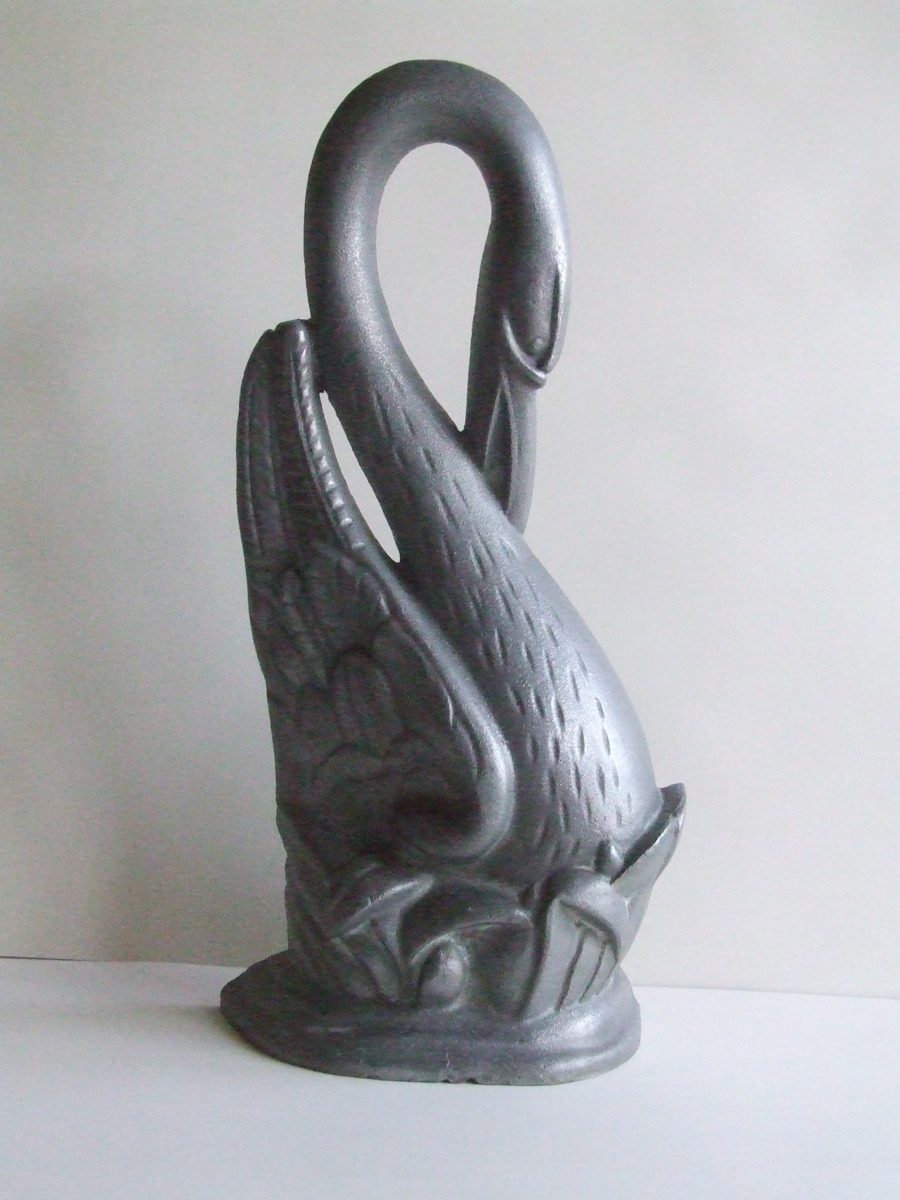 R.H are R. Edwards R. Gibbs. and Ray Leese We continued production until 1986 and the last casting was poured, that being the Swan casting which is on display. On the back of the casting, you will see the initials of the last 4 R`s who worked in the “Brass Shop” Foundry.
Barbican House showed little interest and declined the offer because it wasn’t historic enough ! That was in 1986, 28 years ago and many people are not aware, of there ever being a foundry in Lewes.
In the year 1900 my Grandad Bill Hare started work at John Every Ironworks at the age of fourteen and his job was to work on the furnaces in the Floor Foundry. He left to join the merchant navy and on the completion of service he returned and continued to work on the furnaces in the foundry up to retirement in 1955. My uncle Ted Hare was a moulder in the Floor Foundry in the 1940s to 1950s. My Auntie Winnie worked in the core-shop
from 1950s to 1960s also my uncle RON Hare worked as a fettler during the 1950s to 1960s and my dad Bill Hare was a vehicle mechanic during the early 1960s to the mid sixties.
ESECO at one time had a very successful Social Club. It opened at midday and every evening except Sundays. The Club entered a Table Tennis team in the league and a Snooker and a Darts team and also had stoolball and cricket team.
Because of the nature of the work at ESECO there was a vast turnover of labourers, some stayed for years and others only lasted weeks or even days. One young lad who started working for me early on a Monday morning at 0700 hours and I had explained what was expected of him and showed him how to operate the crane. And his first job was to fetch a barrow load of sand for me to use and when he arrived back with just half a barrow load at 0720 am. He said, “I need to go home to pick –up my cards which I need to hand in today to get it stamped, I won`t be long I only live just around the corner.” Then off he went never to return again .Apparently he lived in Brighton, just 7 miles round the corner.
There was a short period of time when inmates from Lewes Prison were granted daily parole to work at ESECO but it came to an abrupt end when one of the inmates tried to smuggle tobacco back into prison. He had undone the bottom of the packet of shredded wheat and removed the contents from the bottom half and refilled it with packets of tobacco which had bought in several different shops during his dinner break and then sealed the packet with glue which was easily available because glue was used to stick sand cores in the foundry.
Working in the foundry was probably one of dirtiest jobs. The sand was blown off the moulds with compressed air, rather than sucked out with vacuum so black sand particles and dust was airborne at all times. Face masks were available but hardly ever used. I can`t say it was the best job in the world but I found it to be very rewarding because the castings that I produced are still, most probably being used today. The most interesting castings which I made consisted of six separate castings which when bolted together housed electronics which gave- off the same signals as nuclear submarines and were used as decoys. I have also made NON-SPARK-SPANNERS and HAMMERS for the use on Oil-Rigs which prevented explosions when they were used.
After 26 years of working in foundries I became unemployed in September 1986 and in November 1986 at the age of 48 I joined the PRISON SERVICE which took me through to retirement age in 2002. RICH/ BUNNY/ DUSTY
Next: HMP LEWES
4 comments
Dear Ritchie,
I am loving reading about your rich life and feel very honoured to know you and your dear wife. You are an inspiration to me and I cherish you and Joyce. Keep writing down all your memories and stories as you remember them – they really touch people.
Love Wendy
Hello Wendy,
I am pleased you enjoyed the read! We are the lucky ones, by having you as a true friend and you are an inspiration to us! Thank you for being you.
Rich
hi , you may not remember me , I used to work with you at peacehaven . I was there for about 10 years , I used to be on the lathes , I took over old Jim’s job on the large key cutter when he left . I enjoyed those days .the best in my work history .
Hello Dean, I think I remember you, you were the youngest working the lathe, you, wore a long khaki overall and you drove a P reg vehicle which I would have liked to own. Have I got the right man? Bunny Foundry